
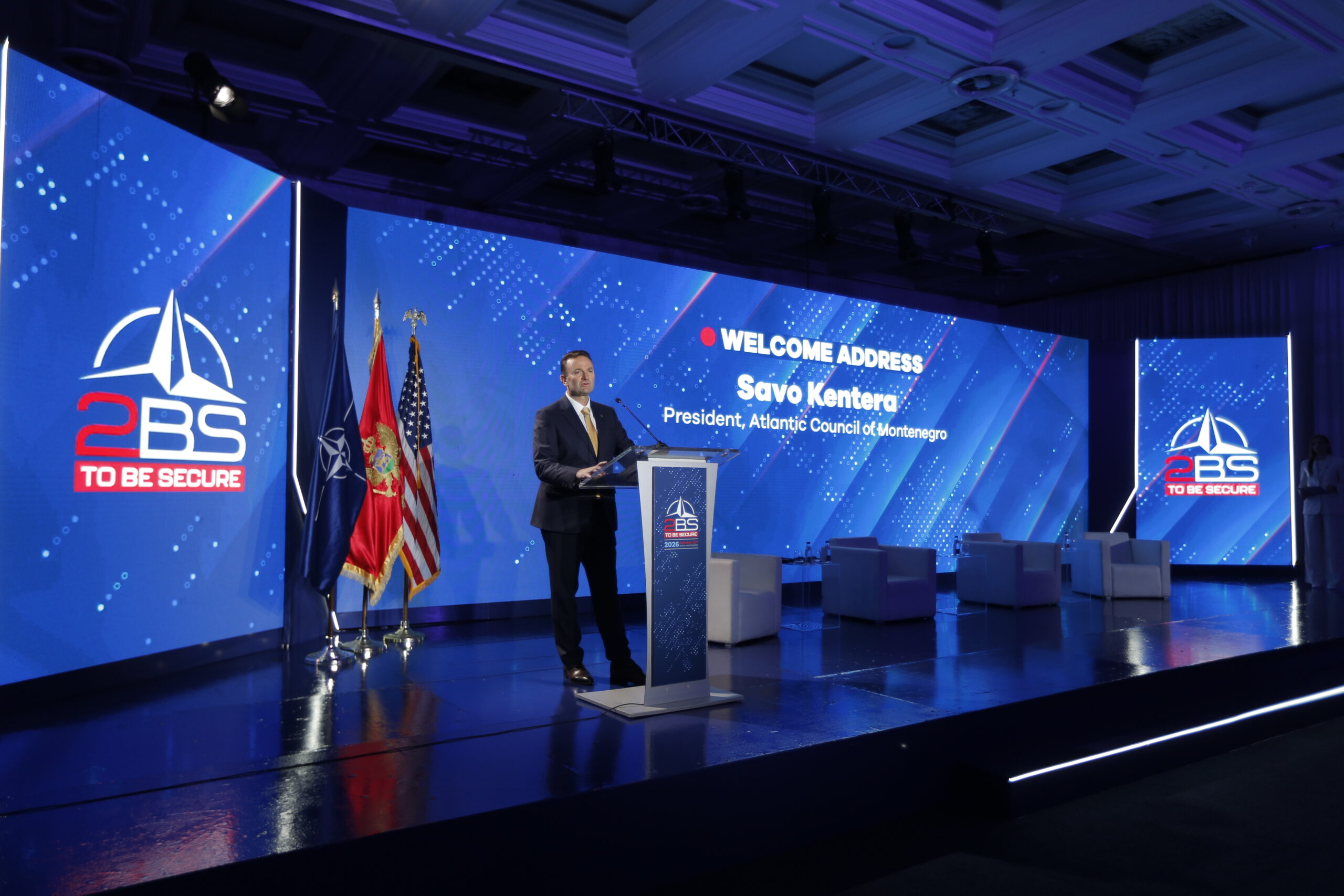
By joining NATO, Montenegro chose its security framework, and it must now complete the second part of its strategic commitment — membership in the European Union. This must not be a project of one government, one political party or one electoral cycle, but a national priority that stands above day-to-day political disputes, said Savo Kentera, President of the Atlantic Alliance of Montenegro, as he opened the 16th 2BS Forum, which is being held today in Budva.
Kentera said that European security can no longer rest on the assumption that peace will endure on its own, and that the threats facing Europe today are no longer hypothetical.
“War has returned to Europe. Critical infrastructure is being targeted. Cyberattacks, sabotage, disinformation and attempts at political interference have become instruments of pressure on democratic societies. But I do not want us to turn yet another opening of this Forum into a list of threats. We know what we are facing. The more important question is: do we have the determination to respond?” Kentera said, noting that Europe lacks neither resources, institutions nor allies. What it must demonstrate is the ability to turn its collective strength into a common decision.
“European democracies have the right to disagree. We will debate the economy, migration, budgets and domestic politics. But we must not allow our differences to become a strategic advantage for those who want a weaker and divided Europe. Unity does not mean that everyone must think alike. Unity means being able to recognise, despite our differences, what we must defend together. That means the security of our citizens, the sovereignty of our states, the freedom of our societies and Europe’s right to decide its own future,” Kentera emphasised.
Kentera stressed that NATO remains the foundation of our collective defence, but that the Alliance’s strength is not measured solely by defence spending, the number of aircraft or modern weapons systems. It is also measured by every potential adversary’s conviction that the Allies will act together when their security is threatened.
“NATO must be so strong that no one ever wishes or dares to test its resolve. That is precisely why we cannot view Russian provocations, sabotage, cyber operations and attempts at destabilisation as isolated incidents. Their impact goes beyond material damage. Their purpose is to test our institutions, our unity and the limits of our resolve,” said the head of the Atlantic Alliance.
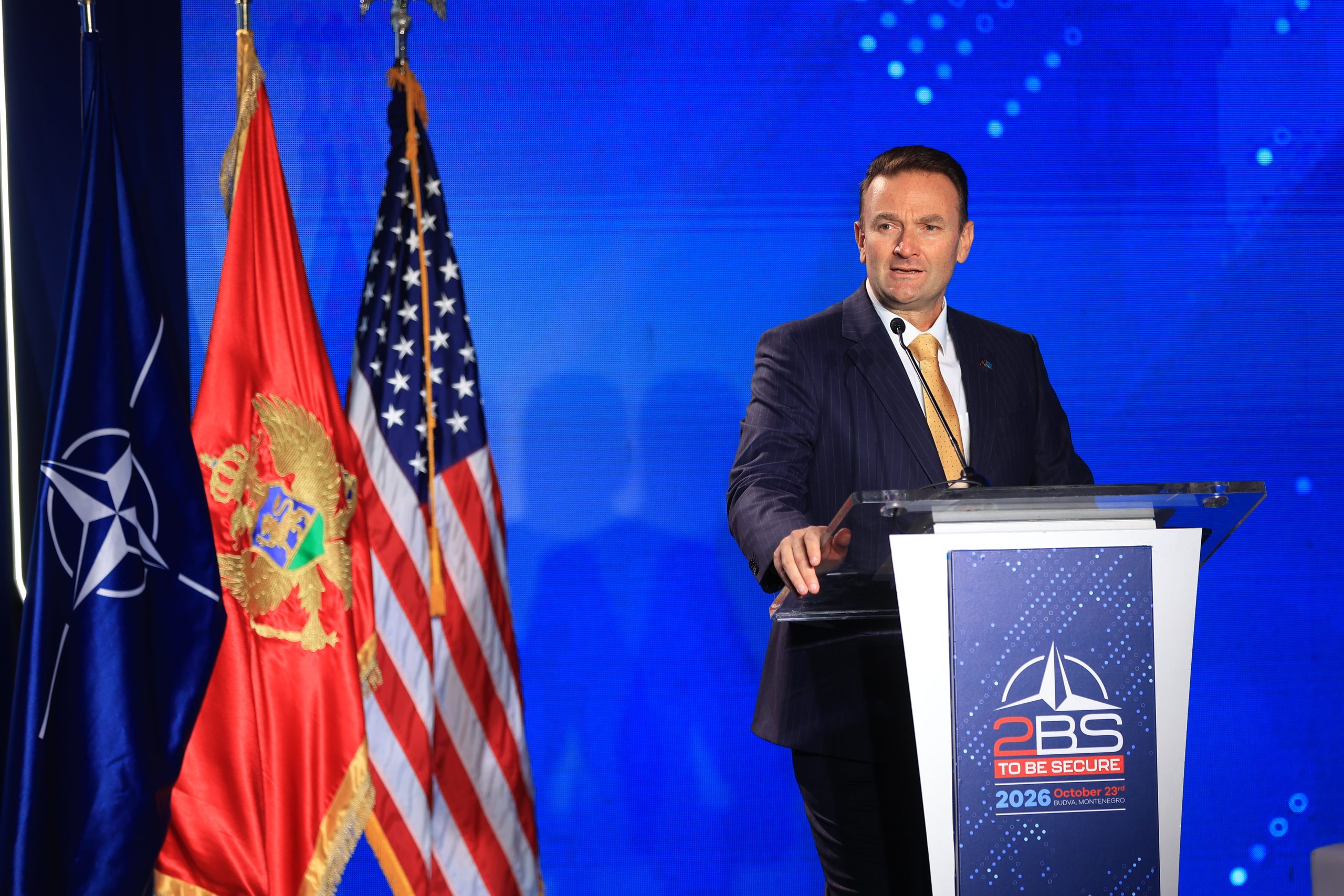
Commenting on the situation in France, Italy and Albania, including protests, violent clashes and increasingly deep social divisions, Kentera said that every democratic society has its problems and that citizens’ right to protest must never be called into question.
“But it would be naive to believe that all the developments we are witnessing today are entirely spontaneous, or that there are no actors who see Europe’s crises as an opportunity to pursue their own strategic objectives,” Kentera said.
Speaking about Montenegro, Kentera noted that, at first glance, European security and a small country’s accession to the European Union might appear to be two separate issues.
“In reality, they are part of the same strategic test: can Europe see its decisions through to completion? By joining NATO, Montenegro chose its security framework. Now it must complete the second part of its strategic commitment: membership in the European Union. This must not be a project of one government, one political party or one electoral cycle. It must be a national priority above day-to-day political disputes,” he said.
According to Kentera, EU membership will not, in itself, solve all our problems.
“No one will carry out institutional reform, uphold the rule of law or ensure accountability to citizens on our behalf. But that is precisely why the European path must serve as a benchmark for our work, rather than a slogan we repeat. Montenegro must demonstrate that it is ready to fulfil its obligations. For its part, the European Union must show that a credible enlargement process truly has an end point.
“Montenegro’s success would be much more than the success of a single country. It would be proof that the European perspective for the Western Balkans is more than just a promise, that reforms pay off and that the region need not remain an arena of perpetual geopolitical rivalry. That is why our European path is a matter of security, stability and strategic consistency. We must not sacrifice it for short-term political interests, internal divisions or the influence of those who benefit from keeping us in a grey zone,” Kentera said.
Kentera said that we must finally stop viewing membership in the European Union as the political objective of a single government or generation.
“It is our obligation to those who come after us. Not only because of European integration, but because of the country we leave them: a country with strong institutions, justice, freedom and a dignified standard of living.
“However different the challenges before us may be, addressing them requires the same things: responsibility, unity and, above all, political determination. We no longer have the right to hide behind new analyses, new strategies and new promises. The greatest danger facing Europe is not merely the strength of those who want to weaken it. The greatest danger is that we, who have the strength to defend it, may fail to find sufficient resolve to do so,” Kentera concluded.
Budva Mayor Nikola Jovanović: Montenegro must maintain continuity in its strategic commitments
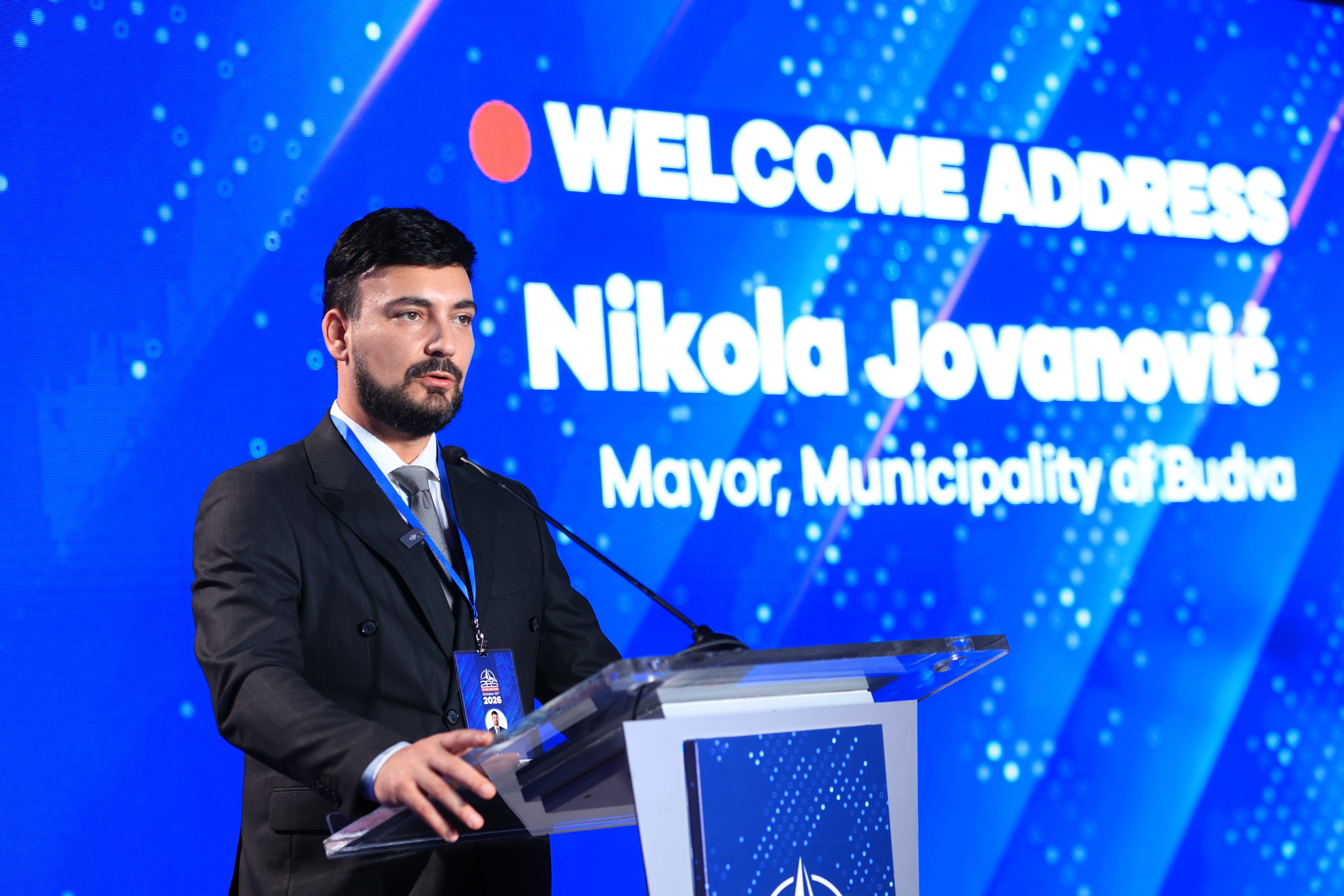
Budva Mayor Nikola Jovanović recalled that this year’s Forum is taking place in a year when the Atlantic Alliance of Montenegro marks 20 years of activity. During that period, he said, the organisation had followed the most important stages of Montenegro’s European and Euro-Atlantic journey and contributed to a better understanding of political and security issues of particular importance to the country.
“Two decades are a sufficiently long period in which to assess the changes that have shaped Montenegro, the region and international relations. During this time, the Atlantic Alliance has established a recognisable role in public dialogue on security and European integration, contributing to the promotion of Montenegro’s European and Euro-Atlantic orientation,” Jovanović said.
Speaking about Montenegro’s European future, Jovanović observed that the process of European integration had shaped the country’s most important foreign policy decisions over the preceding decades and determined the direction of its institutional and social development. He stressed that domestic differences must not jeopardise objectives that are in the country’s long-term interest.
“Montenegro’s European prospects are now unfolding in an international environment considerably more complex than the one in which the integration process began. The war in Ukraine, changes in relations between major powers and increasingly pronounced security challenges have confronted European countries with issues requiring serious political decisions and long-term responsibility.
“In these circumstances, it is particularly important for Montenegro to preserve continuity in its strategic commitments and to ensure that domestic political differences do not jeopardise objectives that are in the lasting interests of the state and its citizens,” the mayor of Budva emphasised.
Jovanović believes that the Western Balkans has had enough experiences over recent decades to remind us how fragile political stability and security can be, and how important it is for the region’s future to be based on responsible relations between states, mutual respect and a clear European perspective.
“Over its sixteen editions, the To Be Secure Forum has maintained continuity in this kind of dialogue, providing an opportunity to discuss complex international relations openly and on the basis of reasoned arguments, while seriously examining the political and security challenges facing Montenegro and our region,” Jovanović said as he opened the Forum.
The organisers noted that this year’s Forum, entitled “A Decade of Results: Montenegro and the Western Balkans in Europe’s New Security Era,” is being held in the year the Atlantic Alliance marks its 20th anniversary.
The Forum will provide a platform for dialogue on key challenges to European and regional security, the future of Euro-Atlantic cooperation, and concrete steps needed to strengthen the resilience of democratic societies.